


March 12, 2026
Key Insights:
● 6G will use terahertz frequencies to provide extremely fast data speeds and almost zero latency.
● AI and edge computing will make networks smarter and able to adapt in real time.
● Immersive technologies like AR, VR, and holographic telepresence will become fully responsive.
● Integrated sensing will allow networks to track motion, localize objects, and monitor the environment.
● 6G will transform industries, healthcare, transportation, and smart cities with seamless and intelligent connectivity.

Estimated Reading Time: 10–12 minutes┃Post by Sophia Carter
When most people hear “6G,” the first thought is typically faster downloads and streaming. But as research and industry work toward what could become a global wireless standard by around 2030, the story of 6G is far more expansive than simply topping the gigabit figures achieved by today’s 5G networks. The evolution to the sixth generation of wireless technology is being shaped around a suite of architectural, spectral, and functional innovations that put connectivity intelligence, sensory capabilities, integrated computing, and environmental responsiveness at the forefront. This conceptual leap—or more accurately this systems-level transformation—promises to reshape how machines, environments, and humans interact in a deeply interconnected world.
At its technical core, 6G research is pushing communication beyond the millimeter-wave frequencies of 5G into terahertz (THz) bands, spanning roughly 100 GHz to several terahertz. These ultra-high-frequency bands offer massive unused spectrum and are suitable for extremely large channel capacity, enabling data rates measured in terabits per second and latency that approaches near-zero in real conditions.

Such improvements dramatically reduce the gap between wired and wireless experiences, making truly mobile broadband indistinguishable in performance from the fastest fiber networks. New front-end technologies like photonic integration and reconfigurable intelligent surfaces (RIS) are being explored to make this spectrum usable, reshaping radio designs and how signals interact with real-world environments.
Yet this isn’t merely a story of physics and hardware. The architecture of 6G is being redesigned around the principle that connectivity should be native to systems and applications themselves, not just a transport layer carrying bits. Terahertz links with embedded compute and edge-distributed processing, combined with machine-learning-driven networks, could allow systems to predictively allocate resources, self-optimize, and adapt to usage patterns in real time, delivering user experiences that are seamless, contextually intelligent, and highly reliable.
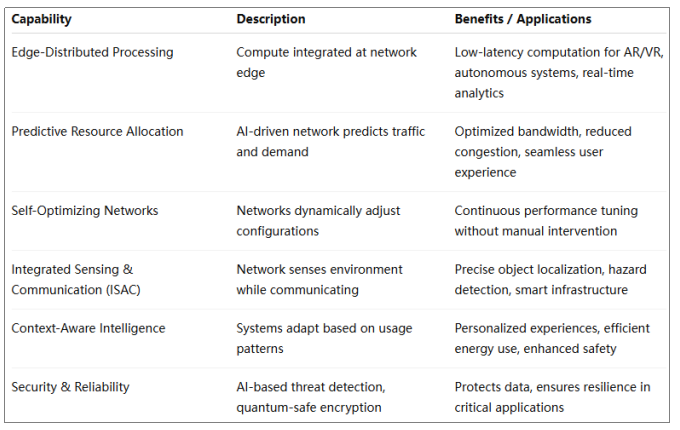
(Table 2- 6G Intelligent Architecture and Capabilities)
In this imagined 6G landscape, latency isn’t just reduced; it becomes imperceptible—enabling commercial and safety-critical applications that previously seemed science-fiction. Augmented reality (AR), virtual reality (VR), and mixed reality (MR) systems could operate with instantaneous responsiveness, opening the door to fully immersive virtual environments for education, remote collaboration, and entertainment. Imagine lifelike holographic telepresence where participants interact in a shared virtual space, or remote surgical robots operating with real-time feedback indistinguishable from being in the same room.
But beyond enabling new ways to see and interact with digital environments, 6G’s integration with sensing and environmental awareness is what could make it a true cognitive network. Integrated sensing and communication (ISAC) blurs the line between communication and real-time environmental data acquisition. This means that future networks could localize objects with precision, sense ambient conditions, and even interpret motion or intent. For robotics, this creates opportunities for safer human–robot collaboration; for autonomous vehicles, it enables precise navigation in complex environments; for public infrastructure, it can support smart traffic management and hazard detection with unprecedented granularity.

The infusion of AI and machine learning at the network level also supports self-healing and self-optimizing systems. Networks that can reconfigure themselves based on predictive models would deliver services with higher reliability while making efficient use of spectral and energy resources. This native intelligence could also improve security, integrating quantum-safe encryption methods and AI-based intrusion detection to protect data in a world where billions of devices—from household sensors to industrial machines—are interconnected.
6G’s transformation extends beyond terrestrial networks into the skies and space. Integration with non-terrestrial networks such as satellite constellations and high-altitude platforms could make ubiquitous connectivity achievable in remote and underserved regions. By unifying terrestrial and satellite assets into a cohesive network fabric, edge computing nodes anywhere on Earth—or near it—could participate in low-latency applications and real-time services.
In industry, the implications of this ultra-high-frequency paradigm are far reaching. For manufacturing, real-time communication between autonomous machines could enable smart factories capable of instantaneous reconfiguration and fault tolerance.
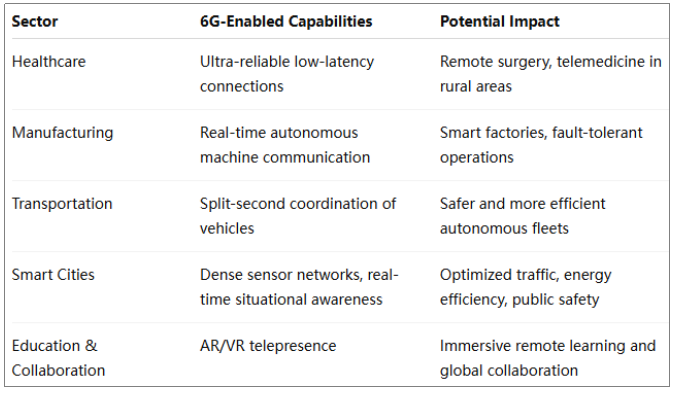
(Table 1- 6G Applications Across Sectors)
In healthcare, ultra-reliable connections with near-zero latency could democratize access to complex medical procedures, effectively extending the reach of specialty care into rural and underserved communities. In transportation, split-second decision making enabled by 6G could make autonomous vehicles both safer and more efficient, coordinating fleets and traffic systems with minimal delay. Smart cities powered by dense 6G sensor networks could reduce waste, optimize resource use, and improve public safety with real-time situational awareness.
It is clear that the significance of 6G lies not merely in achieving higher numerical metrics like throughput and gigahertz figures, but in reimagining how connectivity interfaces with human activity and machine autonomy. Its ultra-high-frequency backbone supports not just traditional wireless communication, but a convergence of communication, computation, sensing, and intelligence. This holistic integration stands to unlock applications we are only beginning to envision—applications where the digital and physical worlds converge in seamless, responsive, and intelligent ways, transforming industries, societies, and everyday life.
FAQs:
1. Can 6G enable truly immersive AR/VR experiences?
Yes. Near-zero latency and extremely high bandwidth could allow lifelike holographic telepresence, real-time collaborative AR/VR, and tactile feedback applications. These experiences could be indistinguishable from interacting in the same physical space.
2. How will 6G support autonomous vehicles?
6G’s combination of low-latency, high-speed communication, and sensing allows vehicles to detect objects, interpret motion, and share situational awareness in real time, improving navigation, safety, and traffic coordination.
3. How will 6G affect personal devices?
Beyond smartphones, AR/VR headsets, IoT sensors, and wearable devices will leverage 6G for real-time, context-aware experiences. Devices may communicate autonomously and interact with their environment intelligently, without heavy reliance on centralized servers.
4. How soon will 6G be available?
Global standards are anticipated around 2030, with research and pilot deployments underway now. Commercialization will likely follow in high-tech, high-value sectors before widespread consumer availability.
(The information in this article was accurate at the time of publication. The tech industry evolves rapidly; readers should verify details before acting.)
Updated March 23, 2026
About the Author
Sophia Carter is a senior technology writer and wireless systems analyst with over a decade of experience covering next-generation telecommunications and emerging network architectures. With a background in electrical engineering and deep expertise in mobile broadband evolution, Avery has authored in-depth reports on 5G deployments, terahertz communication research, AI-driven network optimization, and integrated sensing systems. Avery holds an M.S. in Communications Engineering and regularly speaks at global conferences on the future of connectivity and intelligent wireless ecosystems.
References
[1] UPPCS Magazine. (2025). 6G Technology: What Lies Beyond 5G? Uppcsmagazine.
[2] Signicent LLP. (2024). The Future of 6G Technology & Wireless Networks. Signicent.
[3] RS Inc. (2025). 6G will make ubiquitous cellular connectivity a reality. Rsinc.
[4] Rivaah Creation. (2024). 6G Wireless Technology: The Next Ultra-Fast Revolution. Rivaahcreation.
[5] RI Study Post. (2025). How 6G Will Change Connectivity: Beyond Speed. Ristudypost.

Cloud
Cloud 3.0: The AI-Powered Nervous System of the Digital Economy
Over the past two decades, cloud computing has transformed from a novel IT utility into the backbone of digital infrastructure.
Open Source
Is Open Source Still the Future of Software?
In the span of just a few decades, open-source software (OSS) has moved from niche curiosity to foundational pillar of the software industry.
Sensors
Micro Sensors Are Quietly Transforming the Way Smart Cities Sense and Respond
This is not a far-off science fiction future but a potential reality for the cities of tomorrow. Welcome to the world of micro sensors and their transformative role in smart cities.