


March 19, 2026
Key Takeaways:
● Cloud 3.0 represents the evolution of cloud computing into an AI-integrated, autonomous operating system.
● Hybrid, multi-cloud, and edge computing architectures are central to delivering low-latency, resilient, and distributed intelligence.
● AI is embedded across the cloud stack, enabling predictive scaling, autonomous orchestration, and self-optimizing systems.
● Real-time data processing and decentralized data meshes support continuous intelligence for business-critical operations.
● Cloud 3.0 shifts cloud adoption from cost-saving infrastructure to a strategic enabler of digital transformation and innovation.
Estimated Reading Time: 11–13 minutes┃Post by Zane Archer
The Cloud’s Next Evolution: From Utility to Intelligence
Over the past two decades, cloud computing has transformed from a novel IT utility into the backbone of digital infrastructure. Early cloud models—often called Cloud 1.0—focused primarily on basic Infrastructure-as-a-Service (IaaS), virtual machines, and storage access on demand. Then came Cloud 2.0, marked by the advent of cloud-native platforms, containers, microservices, serverless technologies, and a heavy emphasis on managed services and scalability. These phases enabled businesses to offload infrastructure management, scale dynamically, and innovate rapidly without the massive upfront capital requirements of traditional data centers.
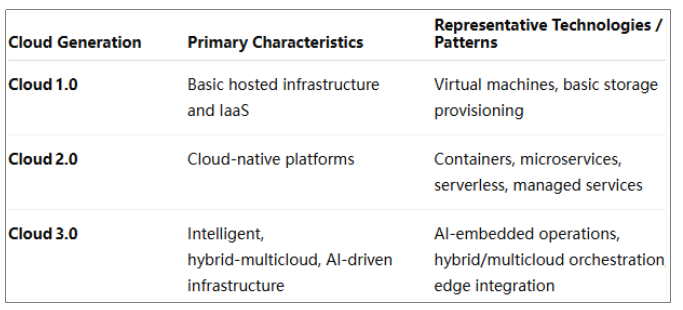
(Table 1- Cloud 3.0 Evolution Overview)
Today, however, cloud computing is undergoing another fundamental shift, one that reframes its role entirely. No longer merely a place to run workloads or host applications, the cloud is evolving into an AI operating system—an intelligent, autonomous, distributed platform that actively powers the future digital economy. This next phase, commonly referred to as Cloud 3.0, is defined not by where workloads reside, but by how intelligently systems operate across hybrid, multi-cloud, and edge environments to serve AI-centric business and technological needs. In this new paradigm, the cloud provides more than infrastructure: it embodies the environment in which data flows, AI models execute, and real-time decisions are made.
At its core, Cloud 3.0 embeds artificial intelligence into every layer of the cloud stack. AI is not an add-on or a specialty service; it’s woven into the fabric of the platform, from automated orchestration and predictive scaling to real-time analytics and security enforcement. This deeply integrated AI functionality enables systems to observe, learn from, and optimize themselves without continuous manual intervention. Rather than reactive scaling based on predefined rules, Cloud 3.0 platforms anticipate demand, redistribute resources autonomously, and ensure optimal performance for both enterprise and consumer workloads. These intelligent capabilities fundamentally reshape what it means for an infrastructure to be “cloud-ready,” making responsiveness and adaptability first-class citizens of the digital stack.

Concurrent with AI integration is the ubiquity of hybrid and multi-cloud strategies. Where early cloud adoption efforts often funneled workloads into a single hyperscaler, Cloud 3.0 assumes distributed architecture as the default operating condition. Enterprises strategically distribute workloads across private clouds, public clouds, and edge nodes to balance performance requirements, data sovereignty concerns, regulatory compliance, cost constraints, and security imperatives. Instead of simply moving workloads to the cloud, organizations now engineer intelligent workload placement that minimizes latency, maximizes resilience, and harmonizes with dynamic business objectives. This shift reflects a more nuanced understanding that flexibility, autonomy, and governance are critical in a world where data is the lifeblood of innovation and economic activity.
With billions of connected IoT devices generating massive streams of data at the network periphery, centralized cloud alone cannot meet requirements for ultra-low latency, local processing, or real-time intelligence. Edge nodes and distributed mini-data centers function as extensions of the cloud, enabling localized computation and decision-making while still integrating with global cloud backends. This distributed topology supports use cases ranging from autonomous vehicles and smart factories to real-time inventory management and personalized healthcare systems—use cases that require both immediacy and synchronization with broader data ecosystems.
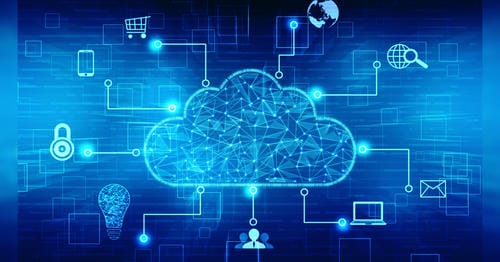
Taken together, these developments signify a conceptual shift: the cloud is not simply a repository or utility platform, but rather an autonomous, intelligent operating system for digital business. It orchestrates computation, data, models, and insights in a seamless continuum, enabling organizations to innovate without disruption and accelerate their transformation journeys. As the digital economy becomes increasingly data-centric, the ability for computing platforms to process, learn, adapt, and respond in real time will be the defining competitive advantage of the era.
The Cloud as the AI Operating System of the Future
At its most expansive, Cloud 3.0 is best described as the AI operating system of the digital economy—an interconnected, intelligent infrastructure that not only hosts applications but powers outcomes. In traditional computing models, operating systems abstract hardware and provide an environment for software to run reliably. Similarly, in the Cloud 3.0 era, the cloud serves as a foundational environment where data, computation, AI models, and business logic converge to produce continuous value. It abstracts away infrastructure complexity while actively managing and optimizing the performance and behavior of connected systems.
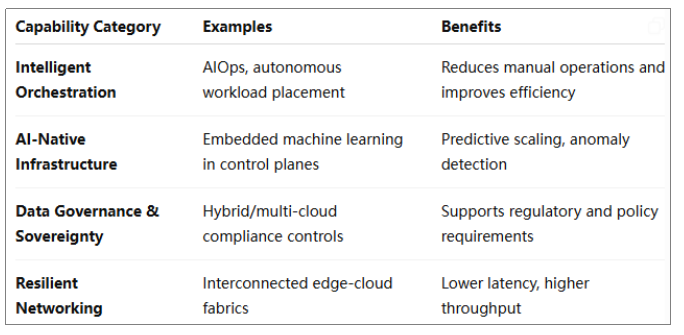
(Table 2- Key Capabilities Enabled by Cloud 3.0)
In this context, AI does not merely assist human operators; it becomes intrinsic to the platform’s control plane. Machine learning models continuously analyze telemetry data to predict demand patterns, optimize resource allocation, enforce security policies, and automatically mitigate threats before they impact users. Intelligent automation becomes the default operational model through AIOps (AI operations) and autonomous orchestration, empowering systems to self-heal, self-optimize, and self-scale in response to shifting conditions. This pragmatic integration of AI reduces operational overhead and enables developers, architects, and business leaders to focus on delivering higher-order value rather than managing infrastructure minutiae.

Furthermore, Cloud 3.0 blurs traditional boundaries between data storage, computation, and analytics. Real-time data processing pipelines, event-driven architectures, and unified data platforms become essential elements of the AI operating system, enabling enterprises to derive insights and execute decisions at the speed of business. Rather than storing vast volumes of data and processing them in separate batch jobs, organizations adopt streaming models and decentralized data meshes that support continuous intelligence. In doing so, they can rapidly innovate in areas such as personalized customer experiences, predictive maintenance, autonomous workflows, and real-time fraud detection.
This evolution also has profound implications for organizational strategy. Cloud 3.0 shifts the conversation from infrastructure migration and cost savings to digital transformation outcomes. Cloud adoption is no longer an IT docket item; it becomes central to corporate strategy, influencing revenue growth, risk management, compliance, and product innovation. Organizations that embrace Cloud 3.0 architectures are better positioned to harness AI at scale, reduce systemic risk, and accelerate time to market for new digital services. For boards and executive teams, this shift underscores the importance of viewing cloud capabilities as strategic assets rather than putative commodities.
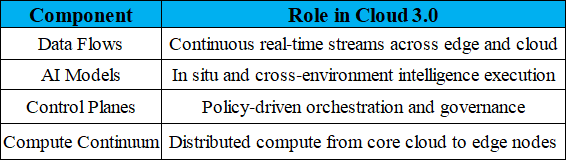
(Table 3- Cloud 3.0: Abstracted Operating Model)
Ultimately, the AI operating system metaphor captures the essence of how cloud platforms are expected to function in the coming years. Instead of static environments that respond to human instruction, Cloud 3.0 platforms act as proactive, intelligent partners in the delivery of digital services. They absorb complexity, learn from context, and execute with precision—all while enabling teams to focus on innovation rather than administration. In the rapidly evolving digital landscape, this transformation represents not just an upgrade of technology, but a redefinition of how enterprises build, scale, and compete in the Age of AI.
(Opinions in this article are personal and do not represent professional advice. Readers are encouraged to perform their own research and draw their own conclusions.)
Updated April 5, 2026
About the Author
Zane Archer is a technology strategist and writer with over a decade of experience in cloud computing, AI integration, and enterprise architecture. As a former cloud solutions architect for major tech consultancies and a regular contributor to industry conferences, Jordan has led cloud transformations for Fortune 500 companies and emerging tech startups alike. Jordan holds advanced degrees in computer science and technology management, and his insights have appeared in leading tech publications.
References
[1] Knowledge Hub Media. (2026). Cloud evolution: Cloud 3.0 and AI-ready infrastructure.
[2] GNS News. (2025). Cloud 3.0: How AI and edge are reshaping the intelligent cloud.
[3] Codevian. (2026). Cloud 3.0 explained: Hybrid cloud benefits, multi-cloud strategy & AI.

6G
6G Will Transform Connectivity, Intelligence, and Sensing Beyond Mere Speed
When most people hear “6G,” the first thought is typically faster downloads and streaming.
Digital Twins
The World in Duplicate: How Digital Twins Are Learning to Predict Reality
For decades, industries relied on models that were, at best, carefully educated guesses. Engineers built simulations, analysts ran forecasts, and planners extrapolated trends from historical data.
Omnimodal Intelligence
Omnimodal Intelligence Will Redefine Machines by Enabling AI to See, Hear, Understand, and Act
Artificial intelligence has advanced rapidly over the past decade, moving from siloed capabilities toward increasingly integrated systems.