


March 19, 2026
In this Arrticle:
● Digital twins are dynamic virtual replicas of physical systems, continuously updated with real-time data.
● They enable predictive insights, helping industries anticipate failures and optimize operations.
● Factories, energy grids, and cities are using digital twins to improve efficiency and resilience.
● Urban and societal applications raise ethical considerations, including privacy and fairness.
● The success of digital twins depends on responsible use, transparency, and interdisciplinary collaboration.
Estimated Reading Time: 12–15 minutes┃Post by Elena Varga
For decades, industries relied on models that were, at best, carefully educated guesses. Engineers built simulations, analysts ran forecasts, and planners extrapolated trends from historical data. These tools were valuable, but they shared a fundamental limitation: they were static representations of a dynamic world. A bridge model assumed fixed loads, a factory simulation assumed stable workflows, and a city plan assumed predictable growth. Reality, of course, rarely cooperated.
From Static Models to Living Mirrors
Digital twins mark a decisive break from this tradition. Rather than being frozen abstractions, a digital twin is a living, continuously updated virtual replica of a physical object, system, or environment. Sensors stream real-time data from the physical world into the digital counterpart, while analytics, physics-based models, and machine learning algorithms interpret what that data means. The result is not merely a mirror of the present but a platform for exploring possible futures.
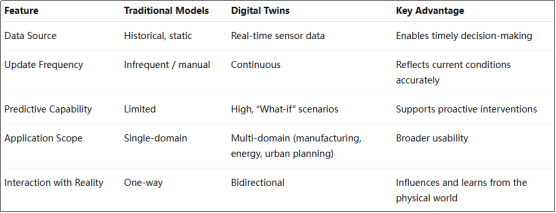
(Table 1- Comparison Between Traditional Models and Digital Twins)
What makes digital twins distinctive is their bidirectional relationship with reality. Data flows from the physical system into the twin, refining its accuracy, while insights flow back from the twin to inform decisions, control systems, and human operators. In manufacturing, this means a production line that can anticipate failures before they occur. In energy, it means grids that adapt dynamically to fluctuating demand. In urban planning, it means cities that can be tested virtually before concrete is poured or policy is enacted.
The concept itself is not entirely new. NASA famously used early forms of digital twins during the Apollo program, maintaining ground-based replicas of spacecraft to diagnose problems in orbit. What has changed is scale and accessibility. Advances in the Internet of Things, cloud computing, edge processing, and artificial intelligence have turned what was once a bespoke, high-cost capability into something that can be deployed across industries and infrastructures. Digital twins are no longer exceptional tools; they are becoming a default layer of modern systems.
Equally important is the philosophical shift they represent. Traditional analytics asked, “What happened?” and later, “What is happening?” Digital twins extend this inquiry to “What will happen if?” They enable scenario testing in ways that were previously impractical or ethically impossible. A factory manager can explore how changing a supplier affects throughput without risking downtime. A city planner can simulate traffic policy changes without subjecting citizens to months of disruption. A hospital system can model patient flows under different crisis scenarios before lives are at stake.
This predictive orientation is why digital twins are often described as virtual clones rather than models. A clone implies fidelity, continuity, and responsiveness. The closer the twin stays to its physical counterpart, the more confidently organizations can rely on it to guide real-world action. As these systems mature, the line between simulation and operation grows increasingly thin, with decision-making distributed across human judgment and machine intelligence.
Industrial Intelligence at Scale
Manufacturing is where digital twins have found some of their most immediate and measurable successes. Modern factories are dense ecosystems of machines, materials, and human labor, all interacting under tight constraints. Small inefficiencies can cascade into costly delays, while unexpected failures can halt production entirely. Digital twins offer a way to make these complex environments legible and, crucially, predictable.
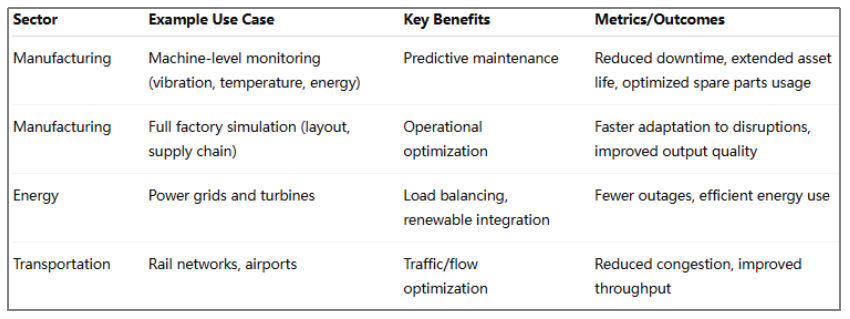
(Table 1- Industrial Applications of Digital Twins)
At the machine level, digital twins track variables such as vibration, temperature, energy consumption, and wear. By comparing real-time data against physics-based models and historical patterns, they can detect anomalies that signal impending failure. This enables predictive maintenance, shifting repair strategies from reactive or schedule-based approaches to condition-based ones. The economic implications are significant: reduced downtime, longer asset lifespans, and more efficient use of spare parts.
At the system level, digital twins model entire production lines or even full factories. They can simulate how changes in layout, staffing, or supply chain inputs affect output and quality. This is especially valuable in an era of volatile global logistics, where manufacturers must adapt quickly to disruptions. A digital twin allows decision-makers to test alternative sourcing strategies or production schedules virtually, identifying optimal responses before committing resources.

Beyond manufacturing, the same principles apply to energy, transportation, and infrastructure. Power utilities use digital twins of turbines, substations, and grids to balance loads, anticipate failures, and integrate renewable energy sources. Transportation authorities model rail networks or airports to optimize flows and reduce bottlenecks. In each case, the twin becomes a shared reference point where engineers, operators, and algorithms collaborate.
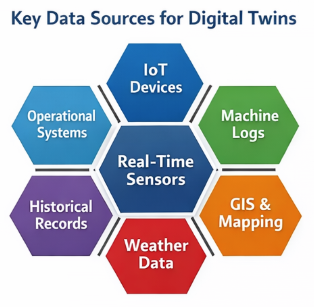
What distinguishes contemporary digital twins from earlier industrial simulations is their integration of multiple domains of knowledge. Physics-based models capture mechanical and thermodynamic behavior, while data-driven models learn from operational history. Increasingly, these are augmented by contextual information such as weather forecasts, market conditions, or regulatory constraints. The twin thus becomes a composite intelligence, capable of reasoning across technical, environmental, and economic dimensions.
This integration also raises questions about governance and trust. When decisions are informed by complex, opaque models, organizations must determine how much authority to delegate to automated systems. In safety-critical contexts, such as aviation or nuclear energy, digital twins are typically advisory rather than autonomous. In other domains, particularly logistics and energy optimization, they may directly influence control systems. The challenge lies in balancing efficiency gains with accountability and transparency.
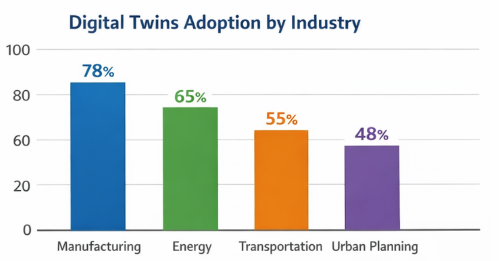
As digital twins scale across enterprises, they also reshape organizational culture. Data silos become liabilities when the value of the twin depends on holistic visibility. Departments that once operated independently must coordinate around shared digital representations of assets and processes. In this sense, digital twins are not just technical artifacts but catalysts for institutional change, encouraging more integrated, systems-oriented thinking.
Cities, Societies, and the Ethics of Virtual Futures
If factories are complex, cities are orders of magnitude more so. Urban environments combine physical infrastructure, natural systems, economic activity, and human behavior in constantly shifting patterns. Digital twins of cities aim to bring coherence to this complexity, offering planners and policymakers a way to understand and shape urban dynamics with unprecedented granularity.
A city-scale digital twin typically integrates data from traffic sensors, public transportation systems, utilities, environmental monitors, and even mobile devices. Combined with geographic information systems and building information models, this data creates a continuously updated virtual cityscape. Planners can simulate how a new transit line affects congestion, how zoning changes influence housing availability, or how extreme weather events propagate through infrastructure networks.
The predictive power of these twins is particularly relevant in the context of climate change. Cities face increasing risks from heatwaves, flooding, and storms, often exacerbated by aging infrastructure. Digital twins allow authorities to test adaptation strategies, such as green roofs or flood barriers, under different climate scenarios. Rather than relying solely on historical precedent, planners can explore plausible futures and prioritize investments accordingly.

However, the expansion of digital twins into social domains raises ethical and political questions. Urban twins often rely on data that reflects human behavior, including movement patterns and resource usage. While such data can improve public services, it also creates risks related to surveillance, privacy, and exclusion. Decisions optimized for efficiency may inadvertently disadvantage certain communities if underlying data is biased or incomplete.
There is also the issue of whose vision of the future is encoded in the twin. Simulations are not neutral; they reflect assumptions about goals, constraints, and acceptable trade-offs. A digital twin optimized for economic growth may prioritize different outcomes than one optimized for social equity or environmental sustainability. As these tools become influential in policy-making, transparency about their design and limitations becomes essential.
Looking beyond cities, digital twins are beginning to model entire ecosystems and even aspects of the human body. Environmental scientists use them to study forests, watersheds, and agricultural systems, exploring how interventions affect biodiversity and resilience. In healthcare, digital twins of organs or patients promise personalized treatment strategies, though they also raise profound questions about data ownership and medical responsibility.
Across all these domains, a common theme emerges: digital twins shift the locus of experimentation from the physical world to the virtual one. This has enormous benefits in terms of safety, cost, and speed, but it also concentrates power in those who control the models. Ensuring that digital twins serve public interests rather than narrow objectives will require new forms of oversight, interdisciplinary collaboration, and public engagement.
As virtual clones proliferate, the boundary between representation and reality becomes increasingly consequential. Decisions made in silico reverberate through concrete, steel, and human lives. The promise of digital twins lies not only in their technical sophistication but in our ability to use them wisely, acknowledging both their predictive power and their inherent limitations.
FAQs
1. What are the ethical concerns surrounding digital twins?
Ethical considerations include:
● Privacy and surveillance due to the collection of human behavior data.
● Bias in decision-making if data is incomplete or unrepresentative.
● Power concentration in those controlling models, potentially influencing policy or resource allocation.
● Transparency and oversight are essential to address these concerns.
2. What is the biggest limitation of digital twins?
Despite their predictive power, digital twins depend on the quality, completeness, and accuracy of input data. Poor data or flawed models can produce misleading outcomes, so oversight, validation, and ethical governance are critical.
(Emerging tech discussed here may be experimental or in beta. Performance and stability can vary, and the author is not responsible for unexpected issues.)
Updated March 30, 2026
About the Author
Elena Varga is a systems engineer and technology strategist with over a decade of experience designing data-driven platforms for manufacturing, energy, and smart city initiatives. She has led digital transformation projects for multinational firms, specializing in simulation, industrial IoT, and predictive analytics. Elena writes about emerging technologies at the intersection of infrastructure, policy, and human systems, translating complex engineering concepts into insights for a global audience.
References
[1] Tao, F., Zhang, H., Liu, A., & Nee, A. Y. C. (2019). Digital twin in industry: State-of-the-art. IEEE Transactions on Industrial Informatics, 15(4), 2405–2415.
[2] Fuller, A., Fan, Z., Day, C., & Barlow, C. (2020). Digital twin: Enabling technologies, challenges and open research. IEEE Access, 8, 108952–108971.
[3] Kritzinger, W., Karner, M., Traar, G., Henjes, J., & Sihn, W. (2018). Digital twin in manufacturing: A categorical literature review and classification. IFAC-PapersOnLine, 51(11), 1016–1022.

Drones and Satellites
How Drones and Satellites Will Power the Next Internet?
As digital demand intensifies—with billions of connected devices, autonomous systems, and real-time AI workloads—the structural limits of ground-based networks are becoming clear.
Edge AI
Edge AI Will Reshape How Energy Is Generated, Distributed, and Consumed
The global energy landscape is entering a period of rapid transformation driven by the convergence of advanced digital technologies and the urgent need for more resilient, efficient, sustainable power systems.
Projects
How Hands-On Projects Unlock Mastery of Next-Gen Technology Concepts Every Enthusiast Should Try?
These projects share a common theme: they take real technologies from current research and industry and break them into manageable, engaging activities that teach principles of design, computation, electronics, and connectivity.