


March 26, 2026
Embodied AI combines perception, reasoning, and action to enable robots to adaptively interact with the physical world, transforming industries and human-robot collaboration.
Estimated Reading Time: 12–15 minutes┃Post by Samuel Lee
The era of artificial intelligence that exists solely in digital space—processing text, optimizing recommendations, or generating images—is rapidly receding. A new frontier is emerging: AI that lives in the physical world, expressed through embodied systems that perceive, reason, and move within human environments. This shift toward physical AI represents a fundamental transformation in how intelligence interacts with reality. No longer confined to static code or isolated datasets, embodied AI embraces the complexities of the real world: it must interpret sensor inputs, navigate dynamic environments, adjust its behavior when conditions change, and execute actions that have tangible consequences. What once seemed science fiction—robots that understand context and can assist meaningfully in our everyday lives—is now steadily becoming technological fact.
How Perception and Action Merge?
Traditional robotic systems have historically been limited by rigid programming and predefined scripts. They excelled in structured industrial settings, executing repetitive tasks with precision but faltering as soon as unpredictability or variability entered the equation. Embodied AI challenges this model by integrating advanced artificial intelligence with sophisticated sensor technologies and adaptive control systems.
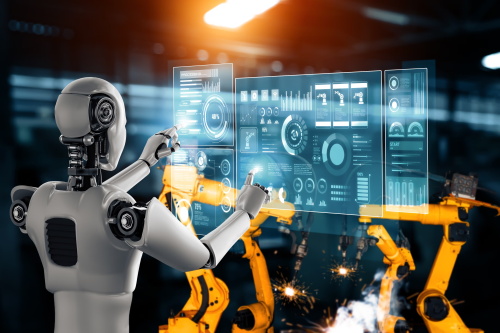
It’s not enough for a machine to think about the world; it must also engage with it. That engagement relies on perception systems such as visual SLAM for spatial awareness, tactile sensors for haptic feedback, and proprioceptive data to understand limb positions and motion. These sensory inputs feed into machine learning models—often built on the foundations of large language and vision-language architectures—that interpret environmental cues and formulate appropriate actions. This synergy of perception, cognition, and motor control transforms robots from deterministic actors into adaptive agents that learn through interaction and response.
Embodied AI is not merely about moving a limb or following a command; it’s about enabling robots to form internal models of their environment and dynamically adjust their behaviors. Cutting-edge research increasingly focuses on vision-language-action (VLA) models that bind perception, language, and motor control into a unified framework.
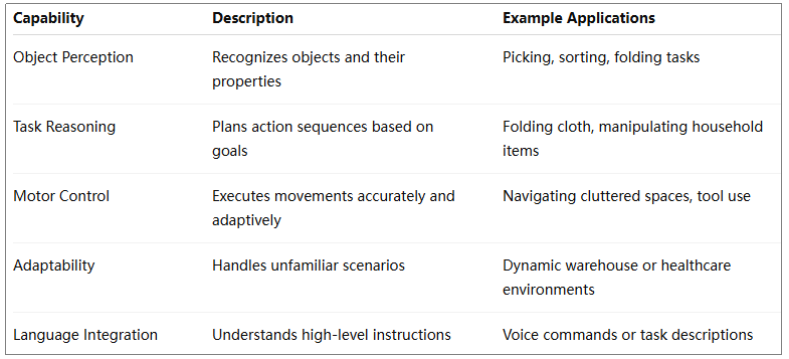
(Table 1- Vision-Language-Action (VLA) Model Capabilities)
These systems allow robots to execute complex tasks based on high-level language instructions, adapting to unfamiliar scenarios without explicit reprogramming. For example, advanced VLA models can perceive an object, reason about the task at hand, and execute a sequence of movements to achieve a goal—whether folding cloth, manipulating household items, or navigating cluttered spaces. This represents a departure from earlier AI robotics efforts that decoupled perception from action and relied on extensive human-coded heuristics.
The integration of AI into the physical realm has catalyzed a host of technological innovations that address longstanding limitations in robotics. Simulation-to-reality training pipelines allow robots to acquire nuanced motor skills in virtual environments before deploying them in real-world operations, greatly accelerating development cycles. Moreover, the combination of reinforcement learning with embodied agents enables continual refinement of behaviors through trial and feedback, akin to how humans learn physical tasks. These developments are fostering a generation of robots that can adapt on the fly, generalize their skills across tasks, and handle environments marked by uncertainty and change—qualities essential for real-world applicability.
The Broader Impact of Embodied AI
Beyond the technical accomplishments, embodied AI is spurring shifts in how industries conceptualize automation and human-machine collaboration.
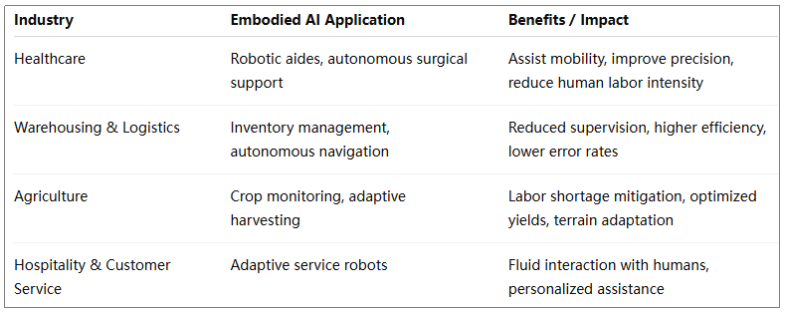
(Table 2- Industry Applications of Embodied AI)
AI-driven robots are poised to augment—and in certain contexts, replace—traditional manual labor across diverse sectors. Autonomous warehouse assistants can navigate through aisles, manage inventory, and interact with goods without constant human direction. Ihealthcare, robotic aides may assist with mobility tasks or operate autonomously in controlled surgical environments. Agricultural robots equipped with vision and decision-making capabilities can adapt to variations in terrain and crop conditions, potentially addressing labor shortages and improving yields. Even in service roles like hospitality or customer support, embodied AI offers the promise of machines that interact fluidly with people and adapt to nuanced social contexts.
The societal implications of this transition are profound. As embodied systems move into mainstream applications, questions of safety, ethics, and workforce disruption come to the fore. Ensuring that robots operate safely around humans involves designing control systems capable of real-time reaction to unpredictable events and integrating redundant sensory safeguards. Ethical considerations extend to decisions about where and how robots should be deployed, especially when their actions influence human welfare or privacy.
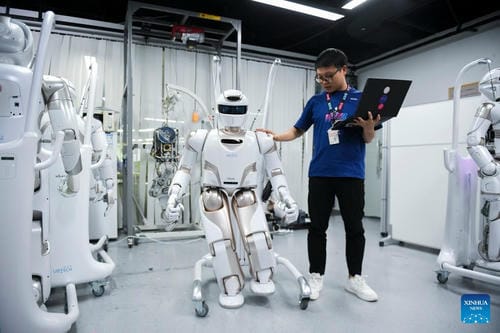
Meanwhile, workforce dynamics are likely to shift as physical AI assumes roles traditionally performed by humans. Rather than simple job displacement, the evolving landscape suggests a reconfiguration of labor: humans may increasingly serve as supervisors, designers, and collaborators with AI systems.
Academic research and industry development are both accelerating toward a future where embodied AI is mainstream. Scientific efforts are now exploring modular humanoid systems that integrate reinforcement learning, language understanding, and visual perception into cohesive agents that operate robustly in varied real-world contexts. Tech companies and startups alike are investing heavily in foundation models tailored for robotic control, sensor fusion algorithms that unify multimodal data streams, and adaptive learning frameworks that endow robots with the capacity to improve continuously through experience. These advances indicate that the next generation of AI will not be confined to server rooms and app interfaces but will coexist with humans in our physical spaces, reshaping how we live, work, and interact with intelligent machines.
(The views expressed in this article are solely those of the author and do not necessarily reflect the opinions of the blog or its partners. All information is provided for educational purposes and should be independently verified.)
Updated March 23, 2026
About the Author
Dr. Samuel Lee is a technology journalist and robotics specialist with over a decade of experience covering the intersection of artificial intelligence and physical systems. Alexis holds a master’s degree in Robotics and Intelligent Systems from the Massachusetts Institute of Technology and has authored numerous industry reports on embodied AI, foundation models for robotics, and human-robot interaction.
References
[1] Reuters. (2025, July 29). Amazon-backed Skild AI unveils general-purpose AI model for multi-purpose robots.
[2] AI Competence. (2025). Embodied AI: How robots learn meaning through vision, language, and action integration.
[3] Evolution of the Progress. (2025). The future of embodied AI: The next leap in robotics and human interaction.
[4] TechCrunch. (2025, March 1). Tech startups race to build next-gen embodied AI robots for home use.
[5] MIT Press. (2025). Reinforcement learning in robotics: Bridging the gap between virtual simulations and real-world robots.

Sensors
Micro Sensors Are Quietly Transforming the Way Smart Cities Sense and Respond
This is not a far-off science fiction future but a potential reality for the cities of tomorrow. Welcome to the world of micro sensors and their transformative role in smart cities.
Digital Distractions
Calm Technology Redefines How We Engage with Digital Distractions
The major platforms and ecosystems of modern tech—from social media feeds to messaging apps—are built to capture and hold your focus as long as possible.
AR
Augmented Reality Transforms Education by Enhancing Cognitive Learning Beyond Gamification
Augmented Reality (AR) has been widely discussed in educational technology circles as a tool to inject engagement and fun into learning, often through gamification.