


March 10, 2026
Key Highlights:
● Cloud computing is transforming climate modeling by offering scalable, on-demand computing power beyond traditional HPC limitations.
● Researchers can run large simulation ensembles faster, improving accuracy and uncertainty analysis in climate predictions.
● Cloud platforms enable global collaboration through shared data storage and accessible workflows.

Estimated Reading Time: 11–13 minutes┃Post by Alexandra Rivera
Climate scientists are facing a profound shift in how they approach environmental prediction. For decades, the computational backbone of climate research relied on high-performance computing (HPC) clusters — specialized supercomputers designed to tackle massive numerical workloads. These systems were essential for running climate models, which synthesize complex equations representing atmospheric physics, ocean dynamics, land-surface processes, and sea ice behavior. Traditional HPC work has always come with high costs, static capacity limits, and steep barriers to entry for smaller research teams. But a new paradigm is emerging: cloud-native climate modeling, where cloud computing platforms supplant or augment traditional supercomputers, offering a radically more flexible and scalable way to conduct environmental simulations.
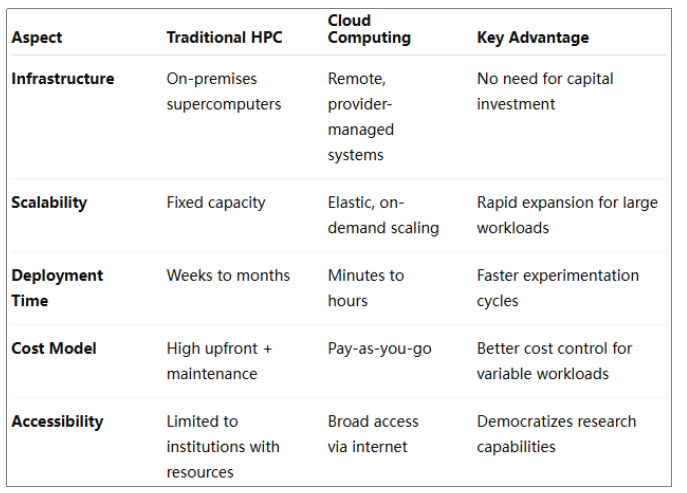
(Table 1- HPC vs Cloud Computing in Climate Modeling)
Scientists leveraging cloud resources can now access elastic compute power on demand, democratizing access to tools and allowing unprecedented experimentation at scale while keeping infrastructure costs under control.
At its core, a climate model is a collection of numerical routines that solve mathematical formulations of physical laws — conservation of mass, momentum, and energy — across a discretized representation of the Earth’s climate system. Historically, researchers ran these models on monolithic HPC clusters with tightly coupled processors and high-bandwidth networking, enabling communication between thousands of compute cores. Today’s cloud offerings include not only general-purpose infrastructure but also HPC-optimized instances with high-performance interconnects and parallel file systems capable of sustaining the demanding input/output patterns typical of climate model workflows. Studies have shown that flagship models like the Community Earth System Model (CESM) can be deployed on commercial cloud platforms such as Amazon EC2 and deliver performance comparable to that of on-premises HPC clusters, with the added benefit of rapid deployment and removal of resources as needed.
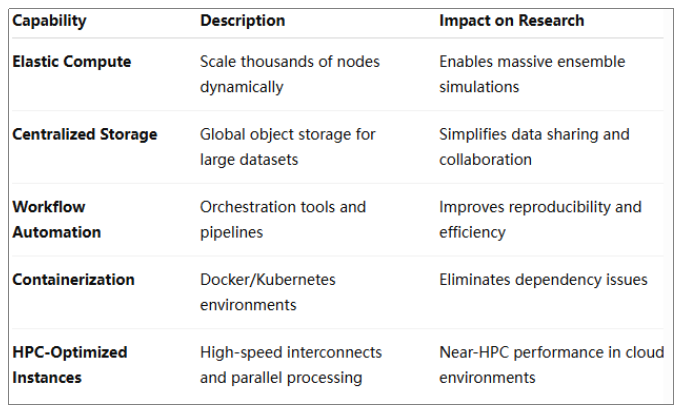
(Table 2- Key Capabilities of Cloud-Native Climate Modeling)
One of the biggest advantages of the cloud lies in elastic scalability. In contrast to traditional HPC environments where researchers must reserve a fixed block of computing time and capacity months in advance, cloud platforms allow teams to provision thousands of compute nodes in minutes and scale them up or down based on workload demands.

This elasticity enables climate researchers to perform large ensembles — many parallel simulations with varied initial conditions — to better quantify uncertainties in projections. Where once running an ensemble of dozens of simulations might have required months of queued time on an HPC cluster, a cloud-native workflow can execute hundreds or thousands of simulations concurrently, significantly shortening turnaround times and enabling more iterative scientific exploration.
The cloud also fosters cross-institutional collaboration and easier data sharing. Modern climate research generates enormous datasets that can easily reach petabyte scales. Moving these datasets between local data centers is both slow and costly. Cloud platforms, by contrast, provide centralized object storage that is durable, highly available, and accessible globally. This allows research teams distributed across institutions and geographic regions to share data, workflows, and analytic results seamlessly, accelerating collaboration and reducing duplication of effort. Scientists no longer need to physically transfer data; instead, they can work directly on shared cloud storage, improving reproducibility and efficiency within the research community.

Beyond raw compute and storage, cloud environments integrate with cutting-edge tools for workflow automation, container orchestration, and data pipeline management. These capabilities enable researchers to build reproducible, automated pipelines for launching simulations, processing outputs, and generating insights. Container technologies such as Docker and Kubernetes facilitate consistent environments across diverse cloud instances, making it easier to package and run climate models without the dependency issues that often plague traditional HPC environments. Managed services for orchestration and serverless functions further enhance automation by coordinating resource allocation and executing components of the simulation pipeline without manual intervention.
In parallel with the transition to cloud infrastructure, machine learning (ML) and artificial intelligence (AI) are increasingly intertwined with climate modeling. ML algorithms are being used to emulate computationally expensive model components, such as parameterizations of sub-grid physical processes, enabling faster approximate simulations that preserve essential physical characteristics. Recent research in the field demonstrates that ML-based surrogate models can replicate the behavior of parts of traditional climate models at dramatically reduced computational cost, allowing scientists to explore much larger parameter spaces than would otherwise be feasible. These techniques can also support uncertainty quantification and rapid sensitivity analysis, powerful tools for understanding complex system behavior and informing policy decisions.
Despite the clear advantages, cloud-native climate modeling does not come without challenges. Moving large datasets to the cloud can incur significant data transfer costs, and researchers must adapt to new workflow paradigms that differ from decades of HPC‐centric development. There can also be concerns around vendor lock-in, where workflows become tied to proprietary cloud technologies. Yet the broader trend toward open-source tools, cloud-agnostic workflows, and standardized data formats helps mitigate these risks. Collaborations between academic institutions, national laboratories, and cloud service providers are accelerating the development of community platforms and shared repositories that make cloud adoption smoother and more cost-effective.
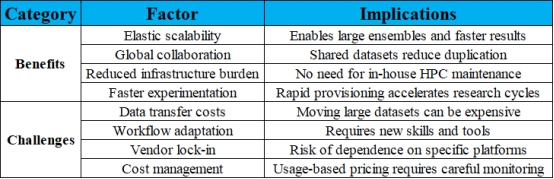
(Table 3: Benefits and Challenges of Cloud-Based Climate Modeling)
The new era of cloud-native climate modeling is not just about replicating what HPC clusters have done in the past — it’s about unlocking new forms of scientific inquiry. Elastic compute enables deeper exploration of uncertainties through massive ensembles; centralized cloud storage enables global collaboration; integrated automation technologies enable reproducible science; and machine learning extends the reach of traditional numerical models through surrogate approximations and data-driven insights. Together, these trends are reshaping how researchers approach environmental prediction and creating a more inclusive, collaborative, and innovation-driven research ecosystem. As cloud technologies continue to evolve, they will likely play an increasingly central role in the global effort to understand and anticipate changes in Earth’s climate.
(The views expressed in this article are solely those of the author and do not necessarily reflect the opinions of the blog or its partners. All information is provided for educational purposes and should be independently verified.)
Updated April 1, 2026
About the Author
Alexandra “Alex” Rivera is a senior technology analyst and writer with over 15 years’ experience covering computational science, cloud infrastructure, and data-driven research technologies. Alex holds a master’s degree in Computational Physics and has worked closely with atmospheric scientists and software engineers on projects.
References
[1] Wyatt Gorman & Joe Schoonover (2022). Weather forecasting using the WRF model on Google Cloud. Google Cloud Blog.
[2] Introducing Riskthinking. AI Climate Earth Digital Twin on AWS. (2025). AWS HPC Blog.
[3] Peter Van Katwyk, Baylor Fox-Kemper, Helene T. Hewitt, et al. (2026). Rewiring climate modeling with machine learning emulators. Communications Earth & Environment. Retrieved from Nature.

Digital Distractions
Calm Technology Redefines How We Engage with Digital Distractions
The major platforms and ecosystems of modern tech—from social media feeds to messaging apps—are built to capture and hold your focus as long as possible.
6G
6G Will Transform Connectivity, Intelligence, and Sensing Beyond Mere Speed
When most people hear “6G,” the first thought is typically faster downloads and streaming.
M2M
The Future of Machine-to-Machine Communication and Its Impact on Industries
In an increasingly connected world, machine-to-machine (M2M) communication stands at the forefront of technological evolution.