


February 28, 2026
Key Highlights:
● Microfluidic cooling embeds tiny liquid channels directly in or near AI chip hotspots for more efficient heat removal.
● It can reduce peak temperatures by up to 65% compared to traditional heat sinks.
● The technology allows higher chip power densities without compromising reliability.
● Industry leaders and research labs are actively developing and testing these solutions.
● Microfluidics represents a shift from external cooling to integrated, co-designed thermal management systems.
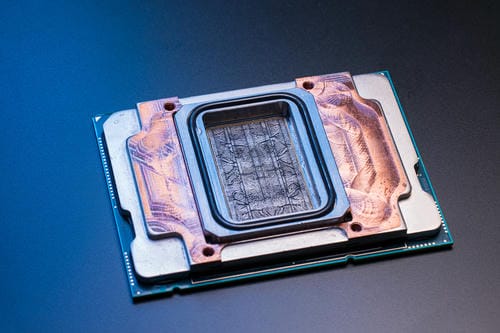
Estimated Reading Time: 11–13 minutes┃Post by Tessa Whitaker
The dream of ever faster, denser, more capable AI systems increasingly bumps up against a hard physical problem: heat. Generative AI workloads, high-performance inference, and ultra-parallel matrix math produce immense thermal energy in chips. Traditional cooling approaches such as fans, large air-moving systems, and conventional heat sinks paired with board-level cold plates are reaching their practical limits in many high-density deployments. As chip power densities climb into the multi-hundreds of watts per chip and data centers push towards megawatt-scale racks, thermal budgets have become a key engineering cost and performance driver across the industry. Air cooling and mounted heat sinks cannot always scale to meet these challenges; designers and system engineers are now turning to advanced thermal management technologies that move beyond passive dissipation and forced air.
One of the most promising emerging methods is microfluidic cooling—embedding tiny liquid cooling channels either in thermal interface layers, chip packages, or even directly into the silicon substrate itself. This hands-on guide explores how microfluidics can transform cooling for your first AI-chip project through next-generation hardware techniques that remove heat where it matters most on the chip, with significantly higher efficiency and potential for sustained performance gains.
What Is Microfluidic Cooling?
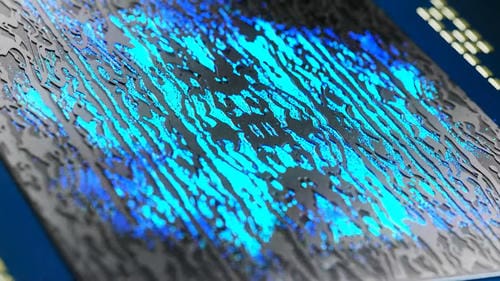
At its core, microfluidic cooling represents a paradigm shift in how we manage heat at the chip and system level. Instead of relying on heat to diffuse from the hottest components into a bulk medium such as air or a large cold plate and then be carried away, this approach uses targeted liquid flow through microscopic channels to convect thermal energy directly from hotspots. These channels can be engineered at micron scales, integrated with processors, GPUs, or dedicated AI accelerators, and optimized so that coolant travels precisely where the thermal gradients are the steepest. In prototype systems demonstrated by major industry players, microfluidic cooling has achieved up to three times greater heat removal than traditional cold plates and reduced peak temperatures by as much as 65 percent depending on workload and chip configuration. Beyond these headline statistics, the granular nature of microfluidic cooling enables finer control over chip thermal profiles, reduces thermal resistance from junction to coolant, and can support higher operating power densities without sacrificing reliability.
How Microfluidics Improves Thermal Pathways
Microfluidic approaches combine several engineering disciplines—fluid mechanics, microfabrication, thermal transport, and control systems. To envision how they differ from traditional cooling, consider the standard path: heat spreads from the transistor junction through the chip substrate, through thermal interface materials (TIMs), into a heat sink, and finally into air. Each interface and material layer introduces thermal resistance, which limits how rapidly and effectively heat can be extracted. With liquid, especially water or engineered dielectric coolants, convective heat transfer coefficients are orders of magnitude higher than with air, allowing much more efficient heat removal. Microchannels placed closer to heat sources shorten the conduction path, drastically reducing resistance and enabling the coolant to absorb energy before it spreads into surrounding materials. On some designs, channels are fabricated so near to transistor arrays that the junction-to-coolant thermal resistance can drop below resistance levels achievable by conventional fluid blocks and heat sinks by an order of magnitude or more. By optimizing channel geometry and flow rates through simulation and AI-assisted design tools, engineers can achieve custom cooling solutions tailored to specific chip layouts and power distributions.

Adopting microfluidic cooling for an AI chip project begins with understanding where and how heat is generated in your workload and how existing cooling limits performance. For example, next-generation GPUs and AI ASICs drive enormous thermal loads in localized regions designed for matrix multiply units and high-frequency logic. Embedding coolant paths directly beneath or adjacent to these regions allows heat to be swept away as soon as it is created, enabling chips to operate more densely and at higher sustained frequencies. This direct immersion of cooling into the chip’s thermal hotspots contrasts sharply with traditional methods that treat cooling as an external add-on after the chip has been manufactured and packaged. Microfluidic solutions can be integrated at various levels: inside the package but outside the die, etched into the backside of the silicon, or as part of a co-designed electronic and microfluidic structure that blurs the lines between computation and cooling. In co-designed systems, cooling and logic interconnects share the substrate, potentially extending performance limits while lowering energy consumption for thermal management.
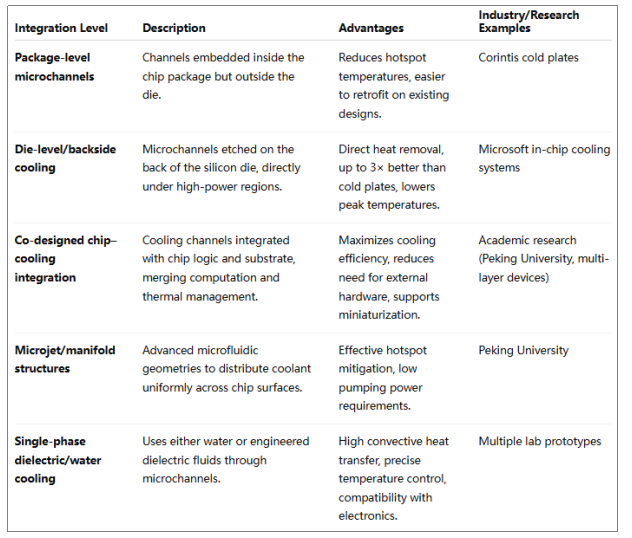
(Table 1- Typical Cooling Improvement)
These advances are not merely theoretical. Major industry players and research labs are actively developing and demonstrating microfluidic cooling techniques that outperform established methods. Microsoft, for example, has developed and tested an in-chip microfluidic cooling system that uses microchannels etched on the back of a chip’s silicon die to guide coolant precisely to high-heat regions. This technique has been shown to reduce peak die temperatures by significant margins and outperform conventional cold plates by up to three times in lab tests, heralding a future where embedded coolant paths are standard in high-performance AI hardware. Similarly, Swiss company Corintis has been working on microfluidic cold plates with channel networks fine-tuned to chip heat maps, showing how chip-specific designs can further improve cooling efficiency and reduce coolant usage compared to one-size-fits-all liquid cooling plates used today.

On the academic side, researchers at institutions like Peking University have developed three-layer microfluidic cooling devices capable of dissipating extremely high heat fluxes with low pumping power, key for managing heat in ultra-compact electronics without massive external pumps or chillers. Their work demonstrates that even with single-phase water coolants, carefully engineered manifold and microjet structures can achieve effective and uniform cooling across a chip surface, addressing hotspots that would overwhelm traditional approaches. Meanwhile, foundational research into co-design strategies emphasizes integrating microchannels within the semiconductor substrate itself, enabling monolithic cooling structures that significantly reduce the need for external dissipation hardware and support future miniaturization of electronics.
( This article is for informational purposes only and does not constitute professional engineering or design advice. Readers should consult qualified thermal management or electronics professionals before implementing microfluidic cooling solutions in production systems.)
Updated March 8, 2026
About the Author
Tessa Whitaker is a hardware systems engineer and technology writer with over a decade of experience working at the intersection of high-performance computing and thermal management solutions. She has led cooling innovation teams at major semiconductor firms, contributed to open-source hardware design projects, and published research on advanced heat dissipation techniques for AI accelerators. Alexandra holds a master’s degree in mechanical engineering with a focus on microfluidic systems and has spent her career helping engineering teams translate cutting-edge cooling research into real-world products.
References
[1] Microsoft develops breakthrough chip cooling method: microfluidic channels can cut peak temps by up to 65%, outperform conventional cold plates by up to 3x. (2025). Tom’s Hardware.
[2] Robb, D. (2025, November 17). Microfluidics could be the answer to cooling AI chips. IEEE Spectrum.
[3] Wei, T. (2020, September 9). All-in-one design integrates microfluidic cooling into electronic chips. Nature.

AI Chips
Microfluidic Cooling Transforms Thermal Management for Next-Generation AI Chips
The dream of ever faster, denser, more capable AI systems increasingly bumps up against a hard physical problem: heat.
Edge Computing
Real-Time Worlds Powered by Edge Computing Transform the Metaverse Beyond VR
The “metaverse” is often discussed in terms of virtual reality (VR) headsets and immersive graphics, but at its core, this next-generation digital realm is a massive distributed computing challenge that extends far beyond display hardware.
M2M
The Future of Machine-to-Machine Communication and Its Impact on Industries
In an increasingly connected world, machine-to-machine (M2M) communication stands at the forefront of technological evolution.